Short answer first, because most people searching this just want the answer before the explanation: for a majority of buyers in Bhubaneswar right now, an under construction flat from a RERA-registered, delivery-proven builder works out better on price and long-term value. Ready-to-move has its place — mainly for buyers who need to shift in immediately or who want zero delivery risk. But the price gap alone is usually 12-20% in favour of under construction, and that gap rarely disappears by the time possession happens.
That said, “usually better” is not “always better.” The rest of this depends entirely on your timeline, your risk appetite, and — this matters more than people admit — which builder you’re buying from.
Here’s the thing most portals won’t tell you plainly: the under-construction-vs-ready debate isn’t really about construction status. It’s about risk transfer. Ready-to-move removes risk and charges you a premium for it. Under construction keeps some risk with you and gives you a discount for carrying it. Once you see it that way, the decision gets a lot easier.
What “Under Construction” Actually Means

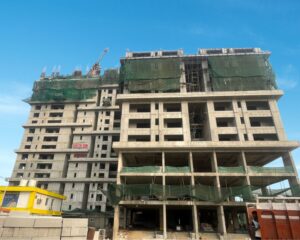
An under construction flat is one where the building is still being built, and you’re buying against a committed possession timeline that’s registered with RERA. The project has to be registered on the RERA Odisha portal before a single unit gets sold — this isn’t optional, and any builder skipping it is a red flag you walk away from, not negotiate around.
At booking, you get an allotment letter, not a sale deed. That’s a common confusion point. The allotment letter confirms your unit and payment schedule; the sale deed comes only after possession. Payment itself typically follows a construction-linked plan (CLP) — you pay in stages as slabs get cast, not the full amount upfront. That single detail changes the entire financial picture, and we’ll come back to it.
Delivery timeline is filed with RERA at project launch. A good developer’s track record on hitting that date — not their marketing brochure — is the thing worth checking. (More on this below.)
What “Ready to Move” Actually Means

Ready-to-move means the Occupancy Certificate (OC) or Completion Certificate (CC) is already issued. You can see the actual flat, walk the actual corridors, check the actual view from your actual floor. No guessing.
One genuine financial plus: no GST applies on ready-to-move or resale units, since GST is charged only on under-construction sales. On an under-construction flat you pay 5% GST (1% for affordable housing category) on the base price. That’s a real number, not a rounding error, and it’s the one place ready-to-move claws back part of the price gap.
What you don’t get: unit choice. By the time a project is ready, the better floors, better-facing units, and corner flats are usually gone. You’re picking from what’s left.
Price Comparison Across Bhubaneswar Localities
Prices vary sharply by locality, and “under construction is cheaper” isn’t a flat percentage — it depends on how far along the project is and how established the micro-market already is.
| Locality | Approx. Rate (₹/sq ft) | Segment Character |
| Khandagiri | ₹4,000 – ₹5,500 | Active mid-income belt, good school access |
| Chandrasekharpur | ₹4,800 – ₹6,200 | IT-professional heavy, strong resale demand |
| Nayapalli | ₹5,200 – ₹6,800 | Established, premium-leaning |
| Sundarpada | ₹3,200 – ₹4,500 | Emerging, wider price room for UC discount |
| NH-16 Corridor | ₹3,500 – ₹5,000 | Growth corridor, largest UC-vs-RTM gap right now |
The NH-16 corridor is worth flagging specifically. It’s still building out its social infrastructure, which is exactly why under-construction pricing there sits meaningfully below what the same specifications would cost once the area matures and goes ready-to-move. Buyers who get in early on a corridor like this are, in effect, buying the area’s future price along with the flat. If you’re still deciding on locality before deciding on construction status, our guide to the best areas to buy a flat in Bhubaneswar breaks down which belts are worth that early bet.
Actual pricing depends on floor, view, and specific builder — treat this table as a planning range, not a quote.
Why Under Construction Wins for Most Buyers
Start with cash flow, because this is the part people underestimate. A construction-linked payment plan spreads your outflow across 18-36 months instead of demanding the full amount on day one. If you’re salaried and building savings alongside a home loan, that structure is easier to live with than a lump-sum ready-to-move purchase.
Then there’s unit selection. Buying under construction means you’re choosing from the full inventory — corner units, higher floors, better-facing flats. Buying ready-to-move means choosing from whatever nobody else picked first.
Price appreciation is the part that needs a caveat, so here it is directly: nobody can guarantee appreciation, and any content claiming otherwise should make you suspicious. What can be said honestly is that historically, in growth corridors like NH-16, prices at possession have tended to sit above launch-phase pricing — because the surrounding infrastructure matures alongside the project. That’s a pattern, not a promise.
There’s also a build-quality angle that doesn’t get discussed enough. Newer under-construction projects are built to current structural codes, current fire-safety norms, and current amenity expectations — open club spaces, EV charging provisioning, rainwater harvesting, things a 2015-era ready-to-move building simply wasn’t designed around.
None of this holds if the builder doesn’t deliver. Which is exactly why the checklist further down matters more than any price table.
Where Ready-to-Move Still Has an Edge
Fair is fair — there are real situations where ready-to-move is the right call, not the fallback option.
If you need to move within 2-3 months — job relocation, lease ending, family expansion — under construction simply isn’t compatible with that timeline, no matter how good the deal looks. Certainty of possession beats price advantage when the calendar is forcing your hand.
Zero delivery risk is the other genuine plus. You’re not exposed to construction delays, material cost overruns getting passed on, or a builder running into cash-flow trouble mid-project. What you see is what you get, today.
And for buyers who’ve been burned before — delayed possession, a builder who went quiet for a year — the psychological comfort of an OC-in-hand flat is worth something that doesn’t show up in a price-per-square-foot comparison.
What to Check Before Buying Under Construction
This is the section that actually protects you, so read it as a checklist, not a paragraph.
- Confirm the RERA registration number on the RERA Odisha portal and cross-check the filed possession date.
- Look at the builder’s actual delivery history — not one project, several, across at least 8-10 years.
- Check whether the project has hit its construction milestones so far, not just what’s promised going forward.
- Read the payment schedule carefully — a CLP tied to genuine construction stages is normal; one demanding large upfront payments before slab work isn’t.
- Ask for the escrow account details required under RERA — funds collected must be used for that specific project, not diverted.
A builder with 30+ completed projects and a multi-decade track record isn’t automatically risk-free, but it’s a very different risk profile than a two-year-old developer on their first launch. That distinction is worth more due diligence time than the floor plan is. If you want to see what a verified, RERA-registered under-construction project actually looks like on the ground, EKAM on NH-16 is a good reference point.
Which One Should You Choose
If your timeline allows 18 months or more and you’re buying from a RERA-registered developer with a visible delivery track record, under construction gives you better pricing, better unit choice, and a payment structure that’s easier on cash flow. That’s the honest recommendation for most buyers reading this.
If you need to move in now, or you’ve decided the price premium is worth zero uncertainty, ready-to-move is the right call — go in with eyes open about the reduced unit choice and higher entry price.
The mistake to avoid either way: choosing based on price-per-square-foot alone. Choose based on the builder’s delivery credibility first. The best price on paper means nothing if possession slips three years past the promised date.
Get Answers:
Is buying an under construction flat safe in Bhubaneswar?
It’s safe when the project is RERA-registered and the builder has a verifiable delivery track record across multiple past projects. Check the registration on reraodisha.gov.in and ask for the project’s construction-stage photos before committing, not just brochure renders.
Do I have to pay GST on a ready-to-move flat?
No. GST applies only to under-construction sales — 5% on standard units, 1% on affordable housing category, calculated on the base price. Ready-to-move and resale flats are exempt since the Occupancy Certificate is already issued.
What is a construction-linked payment plan (CLP)?
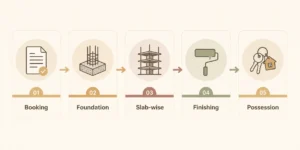
A CLP splits your payment across construction milestones — foundation, slab-wise, finishing — instead of one lump sum. It’s the standard model for under-construction purchases and generally eases cash flow pressure compared to a full upfront ready-to-move payment.
How do I check a project’s RERA possession timeline?
Search the project by name or registration number on reraodisha.gov.in. The filed possession date, builder details, and any updates on delays are listed publicly. Cross-check this against what the sales team tells you verbally.
Can I negotiate price more on ready-to-move flats?
Slightly, but less than people expect. Since the unit is a finished asset with no construction risk left, sellers have less pressure to discount. Under-construction pricing, particularly early in a launch, tends to have more room for negotiation.